Understanding the Waterfall Model in Contemporary Software Development
Despite the popularity of iterative and adaptive methodologies, the Waterfall Model remains a reference point for uderstanding how complex software systems are structured and delivered. It provides a baseline for comparing different development approaches in modern industry contexts.
Why design is critical:
Key points for organizations:
Key considerations:
Maintenance is handled through structured change management processes:
Even organizations investing heavily in AI Development often rely on Waterfall principles for foundational platforms, data infrastructure, or compliance-critical systems. This reflects a pragmatic approach that matches methodology to context rather than trend.
For organizations assessing potential partners, including a software company with global delivery capabilities, understanding how and when the Waterfall Model is applied provides valuable insight into delivery maturity.
For decision makers researching development approaches or comparing providers, familiarity with the Waterfall Model offers valuable context. It helps clarify when predictability and documentation outweigh flexibility and when alternative models may be more appropriate.
The Waterfall Model illustrates how complex systems are planned, designed, built, tested, and maintained through clearly defined, sequential phases - prioritizing predictability, documentation, and governance over rapid iteration.
From an organizational perspective, the model reflects a preference for predictability and control, assuming requirements can be defined early and changes limited during execution. While this does not suit every modern project, it remains relevant in many enterprise, infrastructure, and regulated environments.
Key points for organizations commissioning software:
1. The Waterfall Model as a Foundational Framework
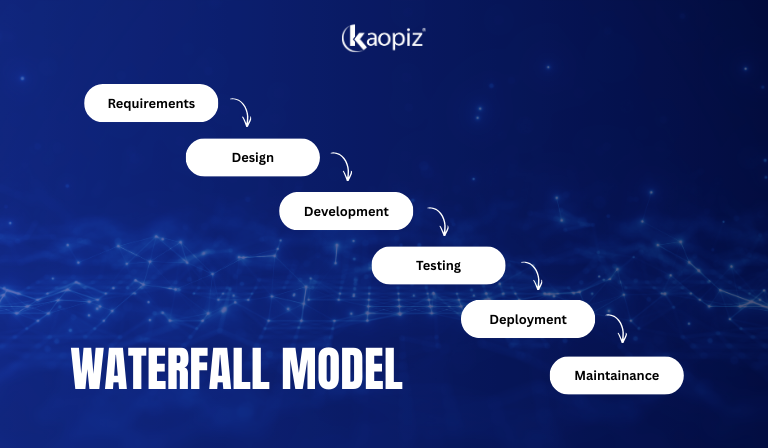
The Waterfall Model is one of the earliest formalized software development methodologies, organizing the lifecycle into a linear sequence of phases completed in order. It emphasizes upfront planning, thorough documentation, and formal approval at each stage.From an organizational perspective, the model reflects a preference for predictability and control, assuming requirements can be defined early and changes limited during execution. While this does not suit every modern project, it remains relevant in many enterprise, infrastructure, and regulated environments.
2. Requirements Analysis and Its Organizational Role
The first phase focuses on gathering and documenting requirements in detail, including functional expectations, non-functional constraints, and business objectives. These specifications form the foundation for all subsequent work.Key points for organizations commissioning software:
- Align internal stakeholders, clarify priorities, and resolve ambiguities before design or development.
- Support more accurate cost estimation and scheduling.
- Enhance transparency and coordination, especially when working with external vendors or distributed teams, such as software companies in Singapore or other regional hubs.
3. Design as a Translation Layer Between Business and Technology
Once requirements are finalized, the Waterfall Model moves into the design phase. Here, business needs are translated into technical solutions, including architecture, data models, interfaces, and system specifications.Why design is critical:
- System functionality and evolution: Design documents provide insight into how the system will operate and scale over time.
- Evaluation of technical trade-offs: Decision makers can assess scalability, maintainability, security, and integration with existing platforms.
- Future readiness: Well-planned designs facilitate the addition of advanced features, such as AI Development, automation, or analytics, without requiring major rework.
- Knowledge transfer and longevity: Detailed designs support onboarding new team members and ensure long-term maintainability, which is crucial for enterprise systems expected to run for many years.
4. Implementation Under Defined Constraints
During the implementation phase, development teams build the system according to the approved design. Deviations are minimal, ensuring alignment with documented requirements.Key points for organizations:
- Execution-focused: Development is guided by predefined specifications rather than exploration, which reduces uncertainty.
- Structured progress tracking: Clearly defined milestones and deliverables make it easier for stakeholders to monitor progress and manage expectations.
- Governance and reporting: Organizations can integrate Waterfall milestones into formal oversight processes, simplifying internal coordination.
- Limited adaptability: Insights gained during implementation typically do not influence scope or design unless formal change processes are initiated, which can be a limitation for dynamic projects.
5. Testing as Formal Verification
Testing occurs after development is complete, with the primary goal of verifying that the system meets all documented requirements.Key considerations:
- Traceability and auditability: Each test case links back to original requirements, providing clear evidence of compliance and functionality.
- Regulatory alignment: Formal verification is especially important in industries with strict regulatory oversight.
- Cost of late discovery: Because testing occurs after implementation, discovering fundamental issues at this stage can increase remediation costs.
- Focus on requirement fulfillment: Testing validates that the system behaves as expected rather than exploring alternative approaches or improvements.
6. Deployment and Maintenance in Stable Environments
Deployment marks the transition from development to production. In the Waterfall Model, this process is controlled and accompanied by comprehensive release documentation and operational handover.Maintenance is handled through structured change management processes:
- Discrete updates: Enhancements and fixes are treated as separate initiatives, rather than continuous evolution.
- Predictability and stability: This reduces operational risk and supports cost control for long-running systems.
- Enterprise suitability: Such an approach is common for mission-critical systems delivered by established software development companies that prioritize maintainability over rapid iteration.
- Governance alignment: Formal processes facilitate compliance and operational oversight, making it easier to manage updates in regulated environments.
7. Strengths of the Waterfall Model
The Waterfall Model offers several strengths when applied in appropriate contexts. Its structured approach provides clear benefits for organizations that require predictability, accountability, and thorough documentation:- Upfront planning: Supports budgeting and scheduling predictability, enabling informed investment decisions early, which is particularly valuable in environments with fixed funding or procurement constraints.
- Comprehensive documentation: Each phase produces artifacts that aid compliance, knowledge transfer, and long-term maintenance. In large organizations, these records often become as valuable as the software itself.
- Clear evaluation points: Phase completion allows stakeholders to review progress and confirm alignment before moving forward, reducing uncertainty and supporting governance.
8. Limitations and Considerations
The Waterfall Model also has notable limitations that organizations should consider:- Rigidity: Once requirements and design are approved, changes usually require formal processes that can increase costs and extend timelines. This makes the model less suitable for projects with evolving requirements or high uncertainty.
- Delayed user feedback: End users typically interact with the system late in the lifecycle, which increases the risk that delivered functionality meets specifications but not current business needs or expectations.
9. The Waterfall Model in Modern Development Ecosystems
In contemporary development environments, methodologies are often combined rather than applied in isolation. While iterative approaches dominate innovation-driven initiatives, structured models like Waterfall continue to support core systems that require stability and governance.Even organizations investing heavily in AI Development often rely on Waterfall principles for foundational platforms, data infrastructure, or compliance-critical systems. This reflects a pragmatic approach that matches methodology to context rather than trend.
For organizations assessing potential partners, including a software company with global delivery capabilities, understanding how and when the Waterfall Model is applied provides valuable insight into delivery maturity.
10. Evaluating Suitability for a Specific Project
Determining whether the Waterfall Model is appropriate depends on several factors.Stable requirements, regulatory obligations, long-term operational use, and fixed budgets all favor this approach.
When evaluating software development companies, organizations should consider not only the methodology proposed but also how change is managed, risks are communicated, and responsibilities are documented.
Conclusion
The Waterfall Model remains a relevant and instructive framework within the broader field of software engineering. While it is not universally applicable, understanding its structure, strengths, and limitations enables organizations to make more informed decisions about software delivery.For decision makers researching development approaches or comparing providers, familiarity with the Waterfall Model offers valuable context. It helps clarify when predictability and documentation outweigh flexibility and when alternative models may be more appropriate.


Nhận xét
Đăng nhận xét